
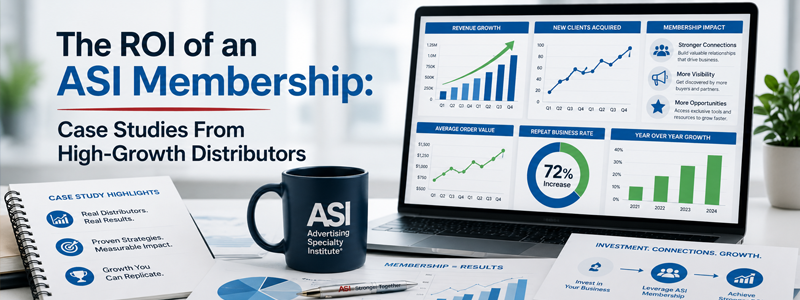




Trade association memberships have a credibility problem. Most charge real money and deliver vague “networking and education” benefits that are hard to put on a P&L. So when distributors ask whether an ASI membership is worth it, the honest answer requires looking at what it unlocks, and how fast that translates into measurable revenue.
Here’s the membership ROI math, with a structural look at why high-growth promotional products distributors treat ASI as infrastructure rather than overhead.
Before calculating return, you must understand what the membership covers. ASI distributor membership unlocks:
The membership cost depends on tier, but for most new distributors the payback math is straightforward: a single mid-size order at trade pricing (compared to retail pricing you’d otherwise be stuck with) typically covers the entire annual membership cost.
One pattern repeats across high-growth distributors who joined ASI in their first year: a side hustler doing $30K-$50K in annual revenue with manual tools hits ESP+, gets supplier credentialing and grows past $200K in revenue within 18 months. The driver isn’t more sales effort – it’s that platform access removes the operational ceiling.
The math: a side hustler spending 15 hours/week on order admin (sourcing, quotes, proofs, invoicing) using spreadsheets and email loses 80%+ of their time to logistics. Moving to ESP+ compresses that to 4-5 hours/week, freeing up 10+ hours of weekly sales capacity. Multiplied across 50 working weeks, that’s 500+ hours of recovered selling time, enough to take a $50K business to $200K without working more total hours.
Existing print shops who add promotional products as a service line see ROI on ASI membership in the first 30-60 days for one simple reason: they already have the customer base; they just couldn’t access promo suppliers without the credential.
A typical $500K-revenue print shop that adds promo through ASI captures 20-30% of existing customers’ merch spend within the first 12 months. That’s $75K-$150K in incremental gross profit on roughly 30-40% margins, against a membership cost that’s a small fraction of the first order’s profit. The print shop’s ROI on the membership is often 50x-100x in year one.
Marketing agencies that join ASI to add custom merch as a service line see a different ROI profile – slower in the first quarter, then accelerating. The reason? Agency clients require strategic program design before merch revenue lands, so the first merch program typically closes in months 2-4.
But once landed, the LTV math is staggering. A single mid-market client’s annual merch program produces $25K-$100K in annual revenue at agency-tier margins, plus a stickiness effect that extends overall retainer length by 12-24 months. Even one closed program in year one returns 10x-30x the membership cost.
The highest-ROI use of an ASI membership is operating company stores – branded e-commerce portals where a client’s employees or customers order from a curated product set, with the distributor managing fulfillment in the background.
One active company store typically generates $3,000-$15,000 per month in product revenue. Three to five active stores produce a six-figure annual recurring base. Distributors who build 10+ stores within their first 24 months – using ESP+ Stores as the platform – develop a recurring-revenue business with the economics of a SaaS company. The membership cost in that context becomes a rounding error.
The honest answer: ASI membership fails to deliver ROI for distributors who don’t actually sell promotional products. Memberships purchased speculatively (“I might get into this someday”) produce no return because no orders are placed and no trade pricing is captured.
ROI requires action. Distributors who join, complete ESP+ onboarding and place their first order within 60 days almost always see positive returns in their first year. Distributors who join and let the platform sit unused don’t see results, regardless of membership tier.
For most distributors, the practical math comes down to three line items:
The honest read is that ASI membership pays for itself fastest for distributors who already have customers but lack the infrastructure to scale them – print shops, agencies, side-hustle promo sellers and existing distributors moving off pieced-together tools. For brand-new entrants, the ROI lands in months 3-6 once the first orders flow through the platform.
For a structural look at why this category is durable through downturns, see Why Promotional Products Remain a Recession-Resistant Business Model. To evaluate whether the timing is right for you specifically, the 5 Signs You’re Ready to Transition From Side Hustle to Full-Time breakdown is the right next read. Or if you’re ready to get started, become an ASI distributor today.
For distributors with existing customers (print shops, agencies, established side hustlers), the membership typically delivers ROI in 30-90 days. For brand-new entrants without a client base, ROI lands in months 3-6 once initial orders flow through the platform.
Yes. The fastest method is comparing retail vs. trade pricing on a sample $5,000-$10,000 order you’d realistically place in your first 90 days. The price difference alone often exceeds annual membership cost.
ASI offers different membership tiers, and most new distributors start with the entry-level tier to validate the business. The platform access and trade pricing are the same – only the marketing services and tier-specific benefits scale up.
No trade association guarantees ROI because outcomes depend on the distributor’s sales activity. What ASI does guarantee is the infrastructure: platform access, supplier credentialing and trade pricing eligibility. The ROI is downstream of how you use it.