
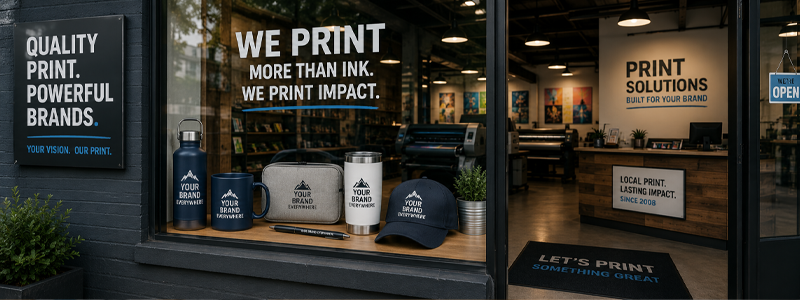




If you run a print shop in 2026, your customers are already buying promotional products – they’re just not buying them from you.
Every time you decorate a stack of business cards for a client, that same client is somewhere else ordering branded pens, T-shirts or trade show giveaways. That’s revenue walking out the door, and the cost of capturing it is far lower than print shop owners assume.
Here’s why adding promotional products as a service line is the single highest-leverage move most print shops can make this year – and how to do it without rebuilding your business.
Print and promo share the same buyer. The marketing manager who orders 500 brochures from you is the same person ordering 200 branded mugs for a customer-appreciation event. The HR director buying onboarding folders is buying employee welcome-kit merch. The event planner buying signage is buying branded swag bags.
The hard part – building the customer relationship – is already done. The next step is becoming the obvious answer when your existing buyers ask, “who can help us with branded merch?”
Traditional commercial print runs on 15-25% gross margins after substrates, ink and labor. Promotional products distribution typically runs 30-40% gross margins because you’re not operating the equipment – you’re sourcing finished decorated products from suppliers and marking up the spread.
For a print shop already doing $500K in print revenue, adding a promo service line that captures even 30% of existing-customer merch demand can add $75K-$150K in additional gross profit annually with no new equipment investment.
Adding promo doesn’t mean buying a heat press or stocking blank apparel. Promotional products distribution is a sourcing-and-fulfillment model: you take the order, source from a vetted supplier through a platform like ESP+ and the supplier ships decorated products direct to your client. Your shop floor stays exactly the same.
This is the structural advantage. Print shops have already invested in customer relationships and the operational discipline (quotes, proofs, deadlines, invoicing) that promo requires.
Your business is already established, and your current infrastructure can support a complementary revenue stream.
One thing most print shops don’t realize: you can’t just call promotional products suppliers cold.
The industry runs on a credentialed supplier-distributor relationship, and suppliers extend trade pricing (sometimes called EQP or NQP) only to verified distributors with a recognized ASI number.
Joining ASI as a distributor gives you access to an ASI credential that suppliers recognize industry-wide, ESP+ for searching 1M+ products across vetted suppliers and trade pricing that lets you compete on cost and still hit 30%+ margins. Most print shop owners are surprised at how fast the ROI math works; membership cost is typically recovered in the first one or two promo orders.
Commercial print is cyclical. End-of-quarter pushes, annual report seasons and event cycles drive feast-or-famine patterns.
Promotional products demand runs on a different cycle: employee onboarding is year-round, customer-gift programs spike in Q4, trade show merch runs spring and fall, and company-store fulfillment is continuous.
Adding promo as a service line smooths out the print revenue curve and gives you something to sell in your slower print months. By Q2 of year one, most print shops that add promo see 15-25% of total revenue coming from promotional products – and the two service lines feed each other when customers ask for integrated branding programs.
Once you offer both print and promo, every customer becomes a larger account. The brochure customer becomes the brochure plus trade show merch customer. The business-card customer becomes the business-card plus onboarding-kit customer. Average revenue per client rises 40-80% in most print shops within 12 months of launching a promo service line.
This is also defensive. If you don’t add promo, your customers eventually find a dedicated promotional products distributor who starts cross-selling them on print. You’re better off being the integrated provider than letting a competitor backdoor your accounts.
The implementation is simpler than most shop owners expect. Here’s the standard 90-day playbook:
For a deeper look at how marketing-services businesses bolt on promo without rebuilding operations, see How Marketing Agencies Can Increase Client LTV via Custom Merch. For an honest look at the membership math, read The ROI of an ASI Membership: Case Studies From High-Growth Distributors.
Most print shops can be fully operational within 30 days of joining ASI. That includes membership onboarding, ESP+ training, supplier credentialing and first sample orders. First closed promo deal usually lands in the 30-60 day window.
Your existing general liability policy almost always covers promo distribution because you’re sourcing finished goods, not manufacturing them. Some shops add a small product-liability rider, but it’s rarely a material cost.
Yes – and that’s the entire ROI argument. Your existing print customers are your warmest leads for promo. Most successful print-shop additions close 60-70% of their first 90 days of promo revenue from existing print customers.
There’s no minimum. Once you have an ASI number, you qualify for trade pricing (sometimes called coded pricing, EQP, or NQP) on every supplier in the network – even on a single $300 order.