
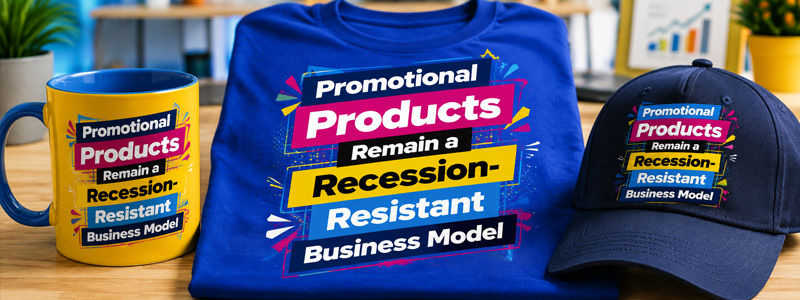




Every time the economy tightens, two things happen: companies cut spending, and consultants warn that marketing budgets will collapse first. Yet the promotional products industry – now a $27 billion market – has expanded through nearly every recession of the last 50 years, including the 2008 financial crisis and the 2020 pandemic. Distributors who understand why this happens are positioned to grow when their competition is retreating.
Here’s the structural case for why promotional products distribution is one of the most resilient B2B business models available to entrepreneurs in 2026.
When marketing budgets are scrutinized, the first cuts are usually programmatic ads, brand sponsorships and unmeasurable campaigns. What stays is anything that produces a measurable result or builds direct customer relationships. Promotional products fall squarely in the “keep” column because they have a long shelf life at a low cost per impression.
With an average cost per impression below $0.005, promo products are orders of magnitude cheaper than digital, print or broadcast advertising. When a CFO is comparing a $5,000 LinkedIn campaign that’ll end in a few weeks to a $5,000 branded-merch program that lives on customers’ desks for two years, the merch wins the budget review.
Promotional products are a sales channel inside every sector. Healthcare clinics buy patient welcome gifts, construction firms buy branded PPE, real estate brokerages buy closing gifts, schools buy team gear, restaurants buy uniforms and government agencies buy event giveaways. A recession that crushes one industry rarely crushes all of them at once.
Distributors who serve multiple verticals (or operate through a platform like ESP+ that gives access to suppliers across all of them) automatically diversify their revenue against any single industry’s collapse. This is structurally different from a marketing agency that depends on three retainers in one vertical.
Modern promotional products distribution isn’t just one-off orders. Distributors with mature businesses run multi-year programs: company stores for employee gear, automated onboarding kit fulfillment, branded recognition programs and recurring trade show merch. These contracts produce predictable monthly revenue that doesn’t evaporate when a client cancels a campaign.
A distributor running five active company stores at $3,000-$8,000 monthly each has a six-figure recurring base before they take a single new order. That’s the cash-flow profile of a SaaS business, not a freelance gig.
Promotional products distributors don’t carry inventory. They source from suppliers, mark up the product, manage decoration and shipping, and collect the spread. Typical gross margins run 30-40%, and the variable-cost model means revenue drops translate almost linearly to lower expenses.
Compare this to traditional retail or wholesale, where fixed costs continue regardless of revenue. A promotional products distributor with $500,000 in revenue can absorb a 30% top-line drop and still be profitable. That structural resilience is exactly what recession-resistant businesses look like.
This may seem counterintuitive, but when economic uncertainty rises, companies often increase spending on employee appreciation, onboarding and retention – because losing talent during a downturn is more expensive than keeping them happy. Branded merchandise, recognition programs and company-swag stores are the front line of that spending.
The 2020-2022 period is the clearest case study. While companies cut travel, events and office build-outs, spending on remote-employee welcome kits, virtual-event merch and “we miss you” client gifts exploded. The category didn’t shrink – it shifted, and distributors who could pivot kept growing.
You don’t need a warehouse, a delivery fleet or six-figure inventory to enter this business. You need a credentialed supplier network, a sourcing platform and industry knowledge. Joining ASI as a distributor gives you all three in a single membership: an ASI number that suppliers recognize, access to ESP+ for product sourcing and order management and the trade education that compresses years of learning into months.
This low-capital entry point means new distributors can start during a recession (when many other businesses pause), build a client base while competition is quieter and emerge from the downturn with momentum that compounds in the recovery.
Recessions historically produce a strong cohort of new businesses – Microsoft, Airbnb, Uber and Slack were all founded during or immediately after downturns. Promotional products distribution is no exception. The combination of low overhead, diversified demand, recurring-revenue potential and a structural cost advantage over digital marketing makes it one of the most defensible B2B paths available to new entrepreneurs.
The decision isn’t whether the industry will hold up. It’s whether you’ll start while there’s still room to claim your niche.
After an initial Q2 2020 dip, the industry recovered and grew through 2021 and 2022, driven by remote-employee welcome kits, hybrid-event merch and increased customer-retention spending. Total industry revenue exceeded pre-pandemic levels by mid-2021.
Practical, daily-use items (drinkware, tech accessories, apparel) outperform novelty giveaways during economic uncertainty. Employee appreciation and customer retention categories also grow because companies prioritize retention over acquisition.
Most distributors start with under $2,000 – primarily for an ASI membership, basic samples and a starter website. There’s no inventory to carry because you source from suppliers per order.
Yes. The U.S. industry has grown to $27 billion and shows compound annual growth in the mid-single digits, driven by employee retention programs, company stores and the shift toward branded e-commerce experiences for clients.