




The fastest way to lose a promotional products client is a botched order from an unreliable supplier.
Late shipments, wrong colors, missing logos or production runs that show up at the client’s door looking nothing like the proof are the kind of failures that kill the deal, along with the relationship and the referrals it would have generated.
The good news? Nearly all of these failures are predictable. Unreliable suppliers have consistent warning signs, and distributors who learn to spot them avoid most of the operational disasters that derail new businesses.
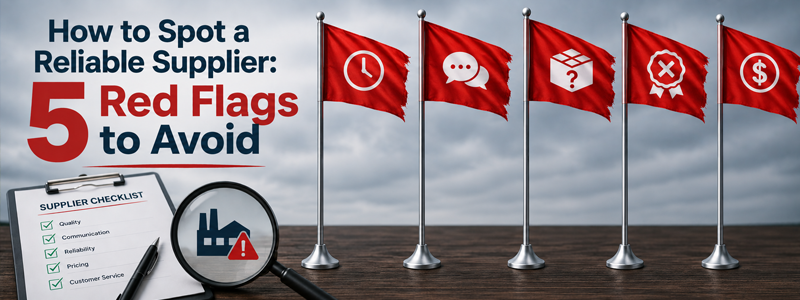
Here are the five red flags every distributor should screen for before placing a meaningful order with a new supplier.
The promotional products industry runs on a credentialed supplier-distributor relationship. Real suppliers participate in industry associations, hold a recognized ASI supplier number and appear in vetted directories like ESP+. A supplier who can’t produce credentialing – or who’s only found through random Google ads or unsolicited LinkedIn outreach – is a structural risk.
This doesn’t mean unknown suppliers are always bad; you’ll just need a higher bar of verification before risking a client order. Distributors operating inside ESP+ get this filtering automatically because the supplier database is pre-vetted – distributors sourcing from cold outreach or unverified marketplaces have to do the verification themselves.
The practical rule: never place a meaningful order ($1,000+) with a supplier you can’t verify through an industry directory or a peer reference.
Reliable suppliers commit to specific timelines in writing: “5-7 business day production after proof approval, plus 3-5 business days ground shipping.” Unreliable suppliers give you ranges that are suspiciously wide (“2-4 weeks production”) or refuse to commit at all (“we’ll let you know when it ships”).
This is one of the most predictive signals. Suppliers who can’t commit to timelines are usually understaffed, overcommitted, or – worst case – outsourcing production overseas without you knowing. Any of these means your client’s deadline is at risk.
Get production and shipping timelines in writing on the quote. If a supplier refuses to commit in writing, treat that as a hard no, especially on time-sensitive orders.
Every reliable supplier will provide a sample on request – either a generic product sample for free or a virtual/physical sample with your client’s branding for a nominal fee ($25-$100). This is industry standard, and it protects both sides from misaligned expectations.
A supplier who refuses to provide a sample, charges an outsized fee for one or insists you commit to a production run “based on the catalog photo” is signaling one of two things: they don’t actually have the product in stock, or they don’t want you to see what the production quality really looks like.
Even more dangerous are suppliers whose physical sample looks great but whose production runs come in noticeably worse. This is the bait-and-switch pattern. The fix is to require a physical sample from the production run for any first order over $5,000, or to start with a smaller pilot order before committing to a large one.
How a supplier communicates during the sales process predicts how they’ll communicate during a problem. Reliable suppliers respond to quote requests within 24-48 hours, use proper email signatures with company contact info, attach formal quotes (not pricing typed in the body of an email) and have a dedicated customer service contact for orders in production.
Warning signs include: response times measured in days rather than hours, single-name signatures with no company info or phone number, communication only through personal Gmail/Yahoo accounts and quotes typed informally with no order numbers or formal documentation.
When something goes wrong – and on enough orders, something always goes wrong – a supplier with disciplined communication during the sales process will resolve it professionally. A supplier with sloppy communication will go silent right when you need them most.
While new distributors might be tempted to assume that cheaper is better, experienced distributors treat dramatically below-market pricing as the biggest red flag of all. Suppliers offering 30-50% below industry coded pricing are almost always cutting corners somewhere – quality, decoration accuracy, production timeline or labor practices in the supply chain.
The most common pattern: a supplier with prices 40% below market wins the order, ships product that looks fine on the surface but has poor decoration durability or off-spec materials. The client doesn’t catch it on delivery, but complaints surface six weeks later when logos start peeling, T-shirts fade after one wash or drinkware fails dishwasher tests. By then the supplier has gone dark and you’re absorbing the replacement costs to save the client relationship.
When pricing is more than 25% below comparable coded pricing across the rest of the industry, treat it with extra scrutiny. Sample one order at small volume before committing real client business.
The standard playbook experienced distributors use:
Even with screening, occasional failures happen. The distributors who keep clients through supplier failures do three things consistently:
Reliability is a discipline. Distributors who systematize their supplier evaluation in their first six months avoid the chaotic operational pattern that kills most new promo businesses by year two.
For the broader operational picture, see our Guide to Mastering the Promotional Products Supply Chain. And for the pricing math that depends on having reliable suppliers in the first place, read What Is “Coded Pricing” and How Do Distributors Calculate Profit.
Most successful new distributors build a Tier-1 roster of 5-10 vetted suppliers within their first 6-12 months, plus access to 50-100+ secondary suppliers through ESP+ for specialty product categories. Going broader than that too early dilutes relationship quality.
No. Price is one of five factors (with reliability, decoration quality, communication and shipping speed). Cheapest pricing often comes with hidden costs – slow timelines, decoration defects or poor recovery when problems occur – that destroy client relationships.
Real industry suppliers participate in trade associations and have a recognized ASI supplier number. ESP+ contains a pre-vetted supplier database, which is the simplest way to verify before placing orders. For suppliers outside the database, ask for credentialing documentation and peer references.
Communicate with the client proactively – don’t wait for them to discover the issue. Pursue the supplier for credit or replacement, but absorb the cost upfront with the client to protect the relationship. Document the failure and remove the supplier from your Tier-1 roster after a second incident.